
Jim Hudak decided he wanted to know more about the namesake for our high school. Jim did the research and wrote a brief article summarizing what he learned, and thought many in our class would enjoy reading it. Hence, Jim’s article follows. Thanks Jim!
J.S.
Bishop Joseph Crétin: The Man and the School
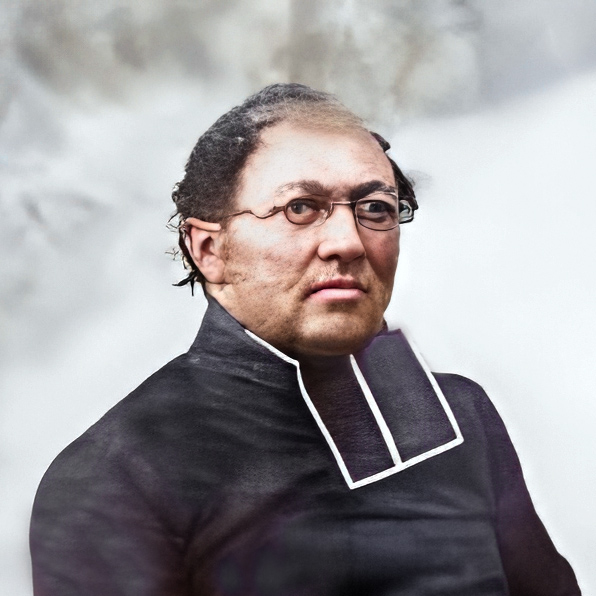
Who Was Bishop Joseph Crétin?
Joseph Crétin was born far from Minnesota, in a small French town that could never have guessed what he would do with his life.
Born on December 19, 1799, in Montluel, France, Crétin grew up in a settled place with old stone buildings and regular church routines. Nothing there hinted at the rivers, wooden chapels, or growing cities he would later know in America.
We don’t know much about Crétin’s parents. Most church records don’t mention them. Instead, what stands out is how Crétin’s life moved away from his hometown and toward a bigger purpose.
In 1838, he volunteered to be a missionary in America and crossed the Atlantic Ocean with Bishop Mathias Loras. After landing in New York, he moved inland and spent over ten years in frontier areas like Dubuque, Prairie du Chien, and mission territories connected by rivers instead of roads. These weren’t easy years. Crétin faced cold weather, limited supplies, and many hardships.
When Rome created the Diocese of Saint Paul in 1850, Crétin probably wasn’t chosen because he was brilliant or charismatic. He was most likely chosen because he already knew how to endure tough conditions.
He arrived in St. Paul on July 2, 1851, traveling upriver by steamboat and landing at the Lower Levee. That same day, he officially took charge of the diocese. That evening, he appeared at the small log chapel that served as the city’s cathedral and blessed the people. There was no break between his arrival and his leadership. The frontier didn’t allow for that.
Crétin lived where he worked. A large brick building at 6th and Wabasha that was completed in 1851 served as cathedral, home, offices, and school all at once. His living space was on the upper floor. Prayer, leadership, teaching, and sleep all happened under the same roof—and with the same exhaustion.
The pace wore him down. Reports from that time describe years of non-stop work followed by long illness, blamed simply on overwork. Joseph Crétin died in St. Paul on February 22, 1857. He was fifty-seven years old and had been bishop for less than six years.
Crétin’s Legacy
Crétin didn’t leave behind fancy symbols. He left structures and systems.
Within months of arriving, St. Paul had a working cathedral complex with classrooms built right into it. In 1852, with the Sisters of St. Joseph, Crétin opened the Cathedral Grade School. Locally, people called it “Cretin’s School.” This wasn’t just a name; it showed that the school was his project.
Education was the backbone of his work. He brought in teaching orders because they made institutions last. Hospitals followed. Cemetery land. Orphan care. Groups promoting sobriety and charity. These weren’t just nice extras. They were answers to frontier problems that couldn’t wait.
During Crétin’s short time as bishop, the diocese grew quickly—more churches, more missions, more clergy, and a rapidly growing Catholic population spread across a huge territory. What later became Cretin High School, and eventually Cretin-Derham Hall, grew directly from this early framework.
The man died young. The systems did not.
That’s the difference between Crétin the man and Crétin the institution: one body failed under the load; the other carried it forward for generations.
From “Cretin’s School” to Cretin High School
By the early 20th century, the original Cathedral school had already split and recombined several times, but one thing stayed constant: boys’ education staffed by religious orders, built for discipline and structure, not experimentation.
Key changes:
- Late 1800s: The boys’ school tradition started under Crétin becomes more formal.
- 1871: The Christian Brothers arrive in St. Paul. This is a turning point. From then on, the boys’ school has a more organized educational approach.
- 1928: Cretin High School opens at the Hamline & Randolph campus—the location that defined the school for generations.
That campus mattered. It was large, visible, permanent. This is when “Cretin” stops being just a historical echo and becomes a place.
Sources
(in French) Persee:
https://www.persee.fr/doc/arcpa_0000-0000_1880_num_11_1_5855_t1_0716_0000_17?utm
An official list of collections in French relating to the reorganization of France after the French Revolution.
“Text of the decrees concerning the division of the kingdom in the annex of the session of February 26, 1790,” referring to the National Assembly’s crucial decisions to reorganize France into new administrative units (départements) during the French Revolution, establishing a more uniform national structure instead of old provinces.
Ramsey County Historical Society
https://rchs.com/wp-content/uploads/2015/11/RCHS_Fall1969_Forgotten_Pioneers.pdf
Article on Bishop Cretin
Notre Dame Archives
https://archives.nd.edu/calendar/c185703.htm?utm
Various references to Bishop Cretin
Wikipedia: Second Cathedral of Saint Paul, MN.
https://en.wikipedia.org/wiki/Second_Cathedral_of_Saint_Paul_(Minnesota)
New Advent Catholic Encyclopedia
https://www.newadvent.org/cathen/04487b.htm
Summary description of Bishop Cretin’s life
Note the reference to 6th and Wabasha in the article. Jim sent me a note saying “That always caught my attention, right there in downtown St. Paul at 6th and Wabasha. At 11 years old, I’d take the bus to downtown, where they flooded 6th street (as I recall it, anyway), store entry areas let us put on our skates, and we’d skate up and down 6th street between St. Peter and Wabasha. I thought that was pretty cool and meant I grew up liking St. Paul as a great place to live, even in winter. – Jim “